

Industrial asset visibility, business continuity and incident readiness took centre stage during our participation in CS4CA LATAM Brazil 2026. In an interactive session built around real-world cyber incidents, our CEO, Pedro Estévez Fernández, explored how the decisions made in the early stages of an attack can determine the scale of disruption to industrial operations.
On October 27–28, Greinfort took part in CS4CA LATAM Brazil 2026 in São Paulo, joining cybersecurity specialists and critical infrastructure professionals to discuss the challenges facing today’s industrial environments.
As industrial operations become increasingly connected, the boundaries between information technology (IT) and operational technology (OT) continue to blur. This transformation brings new opportunities for efficiency and innovation, but also introduces security risks that conventional IT approaches alone cannot adequately address.
Industrial cybersecurity is no longer just about keeping attackers out. It is about maintaining safe, reliable operations when systems are compromised and ensuring that organisations have the information and capabilities needed to respond effectively.
Our participation in Brazil provided an opportunity to exchange expertise with industry peers and contribute to a critical discussion: how can industrial organisations contain cyber threats while protecting operational availability, safety and business continuity?
“You can’t protect what you can’t see”: Building security on visibility
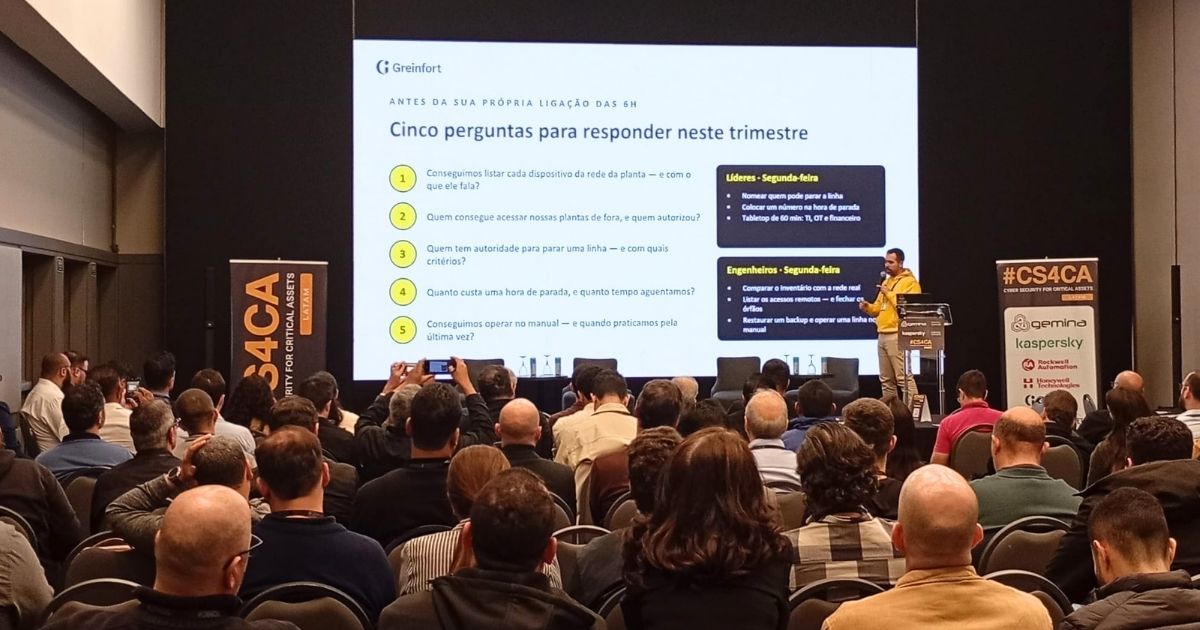
A key highlight of our participation was a session delivered by our CEO, Pedro Estévez Fernández, entitled The 6 AM Call: Four Decisions That Decide How an OT Crisis Ends, and What to Do Before the Phone Rings.
Rather than focusing on theoretical threats, Pedro challenged the audience with a realistic crisis scenario: an early-morning call reporting that operators at a manufacturing plant had lost control of a production line.
The exercise followed MetalSul, a fictional manufacturer with three facilities across Brazil and Mexico, as its leadership team faced four critical decisions involving asset visibility, operational continuity, financial exposure and ransomware response.
Each decision was supported by lessons from real incidents involving Colonial Pipeline, Jaguar Land Rover, JBS and Norsk Hydro, illustrating how choices made under pressure can affect production, safety and the wider business.
One of the session’s defining messages was “You can’t protect what you can’t see.”
For industrial organisations, this means having an accurate picture of the assets operating across their OT networks, understanding how those assets communicate and identifying the external connections that could expose critical systems to attack.
Industrial environments often contain a complex mix of programmable logic controllers (PLCs), human-machine interfaces (HMIs), engineering workstations and communications infrastructure. Many of these systems have been in service for years, sometimes decades, and may not be reflected accurately in existing asset inventories.
Without reliable visibility, identifying suspicious activity, tracing unauthorised connections and containing an incident becomes considerably more difficult.
At Greinfort, we address this challenge through specialised capabilities for industrial asset discovery, passive network monitoring and anomaly detection. By providing insight into OT communications without disrupting production, our technology helps security teams understand what is happening across their industrial environments and respond with greater confidence.
When cybersecurity meets production: Who makes the call?
One of the most thought-provoking moments of Pedro’s session explored a familiar dilemma in industrial incident response: should an organisation shut down operations to contain a potential cyber threat, or keep production running while investigating the incident?
The answer is rarely straightforward.
Security teams are focused on preventing an attack from spreading. Plant operators, meanwhile, must consider the safety implications, equipment constraints and operational consequences of stopping industrial processes.
In an OT environment, a poorly coordinated shutdown can create additional risks, making decisions about containment fundamentally different from those typically taken in corporate IT.
As Pedro emphasised, “Decide who stops the line — before the crisis.”
The 2021 Colonial Pipeline ransomware attack demonstrated why this matters. Although the attack initially affected corporate IT systems, uncertainty surrounding its potential impact prompted the company to suspend pipeline operations.
The resulting disruption lasted several days and contributed to fuel shortages across parts of the eastern United States.
The lesson is not that shutting down operations is necessarily the wrong decision. In some circumstances, it may be the safest course of action.
What matters is having clearly defined responsibilities, agreed decision-making criteria and tested isolation procedures in place before an incident occurs.
At Greinfort, our approach focuses on giving security teams the visibility and operational context they need to identify abnormal behaviour, assess threats and support appropriate containment measures.
Effective incident response requires more than speed. It requires an understanding of the industrial processes that security decisions may affect.
The true cost of a cyber incident is measured in production downtime
Financial exposure was another major theme of the presentation.
In Pedro’s simulated scenario, MetalSul faced losses of $315,000 after just over five hours of disruption, based on an estimated production downtime cost of $60,000 per hour.
Although the figures were illustrative, the underlying challenge is very real: many industrial organisations still struggle to quantify the financial impact of losing access to critical production systems.
According to Siemens’ The True Cost of Downtime 2024 report, an hour of unplanned downtime at a large automotive manufacturing facility can cost approximately $2.3 million. The estimate covers downtime from all causes, not cybersecurity incidents alone.
The consequences can also extend far beyond the affected facility.
The September 2025 cyberattack on Jaguar Land Rover forced production to stop at its main UK manufacturing plants for several weeks, affecting suppliers and businesses throughout the automotive supply chain.
The UK’s Cyber Monitoring Centre subsequently estimated the wider economic impact at approximately £1.9 billion.
These incidents demonstrate why cyber risk needs to be assessed in operational and financial terms, not solely through technical indicators.
Understanding which processes are critical, the systems they depend on and how long the business can withstand an interruption is essential to effective business continuity planning.
Reliable asset visibility and network intelligence provide an important technical foundation for these assessments, helping organisations identify dependencies and prioritise protection where disruption would have the greatest impact.
Brazil and Spain: Different industrial landscapes, shared cybersecurity challenges
Our participation in CS4CA LATAM Brazil also highlighted the importance of industrial cybersecurity across two markets with distinct economic structures but increasingly similar operational security concerns.
Brazil’s extensive manufacturing, energy, mining, automotive and agribusiness sectors depend heavily on industrial automation and interconnected control systems. As these environments become more digitally integrated, protecting operational infrastructure is an increasingly important priority.
According to Kaspersky ICS CERT, malicious activity was detected and blocked on 18% of the industrial control system (ICS) computers monitored in Brazil during the second quarter of 2025.
Spain faces comparable challenges as industrial organisations modernise their infrastructure and connect legacy operational systems to increasingly complex digital environments.
INCIBE reported 122,223 cybersecurity incidents in Spain in 2025, representing a 26% increase compared with the previous year.
While these figures reflect different methodologies and cannot be directly compared, they illustrate the broader cybersecurity pressures facing both markets.
Regulatory developments further underline the importance of strengthening cyber resilience.
Brazil introduced an updated National Cybersecurity Strategy in 2025, placing greater emphasis on the protection of essential services and critical infrastructure.
Across Europe, the NIS2 Directive has raised expectations for cybersecurity risk management and incident reporting among organisations operating in critical sectors, with significant implications for Spain’s regulatory framework.
Despite their differences, industrial operators in both countries face many of the same challenges: securing legacy systems, managing remote access, maintaining visibility across OT networks and detecting threats without disrupting production.
Our technology is designed to address these operational realities, providing industrial organisations with the visibility, threat detection and response capabilities needed to strengthen security across their OT environments.
“Only the prepared get to say no”: Building resilience against ransomware

The final stage of Pedro’s presentation addressed one of the most difficult decisions an organisation can face during a cyber crisis: whether to pay a ransomware demand.
In the MetalSul scenario, attackers demanded $2 million to restore access to compromised systems, forcing the leadership team to assess its recovery options under mounting financial pressure.
To illustrate the consequences of different approaches, Pedro drew on two major industrial ransomware incidents.
In 2021, Brazilian multinational JBS confirmed that it had paid $11 million following an attack that disrupted operations across several countries.
Norsk Hydro took a different approach after suffering a ransomware attack in 2019. The aluminium producer refused to pay, instead isolating affected systems, restoring operations from backups and relying on manual processes where necessary.
Both cases highlight the importance of preparation, tested recovery procedures and the ability to maintain essential operations when digital systems become unavailable.
As Pedro summarised, “Only the prepared get to say no.”
The ability to detect threats early and contain malicious activity can help limit the damage caused by an attack. However, effective resilience also depends on tested backups, business continuity plans, recovery exercises and close coordination between cybersecurity, operations and executive leadership.
Technology is a critical part of that preparation, but it cannot replace the organisational readiness required to manage a major incident.
Cyber resilience starts long before an incident
Our participation in CS4CA LATAM Brazil 2026 reinforced a fundamental principle of industrial cybersecurity: the outcome of a cyber crisis is often shaped by decisions made long before the attack begins.
Knowing which assets are connected to OT networks, understanding how they communicate, detecting unusual activity and establishing clear incident response procedures all contribute to reducing uncertainty when an organisation is under pressure.
Through his presentation, our CEO highlighted why industrial resilience must go beyond preventing attacks. It also requires the ability to contain disruption, make informed decisions and restore operations safely.
At Greinfort, this perspective underpins our approach to industrial cybersecurity. By combining specialised OT visibility, threat detection and response capabilities, we help organisations build a clearer understanding of their industrial environments and strengthen their ability to respond to emerging threats.
Because when a cyber incident threatens production, the difference between a contained disruption and a major operational crisis may come down to decisions made long before the first alarm is raised.